> For the complete documentation index, see [llms.txt](https://docs.decisionrules.io/doc/llms.txt). Markdown versions of documentation pages are available by appending `.md` to page URLs; this page is available as [Markdown](https://docs.decisionrules.io/doc/organization/settings.md).
# Settings
The Settings module provides an interface for managing various aspects of your organization. It offers access to basic information, subscription and billing details, configuration options for Single Sign-On (SSO), and sensitive functionalities within the Danger Zone, including the ability to delete the organization.
Organization settings
## Organization Info
The Organization Info section of Settings displays important details about your organization. This includes:
* **Organization name** - The name of your organization.
* **Organization Id -** Unique organization identifier
* **Description -** optional field to describe organization
To change organization information, such as its name or description, you must be an active **Owner** or **Admin** of that organization. A **Viewer** can read the organization information but cannot save changes to it.
### Subscription & Billing
In the Subscription & Billing section, you can access information related to your organization's subscription and billing. This includes:
* **Subscription Plan -** Details of the current subscription plan.
* **Billing Account -** Email address of the account responsible for Organization limits
* **Next billing date:** Information about the next billing date.
{% hint style="warning" %}
**Payment Method** and **Invoice History** are only visible in the billing account detail.
{% endhint %}
### Single Sign-On (SSO)
Configure SSO for your organization. (More information how to set SSO up, you can find [here](/doc/access/cloud/single-sign-on-sso.md#how-do-i-set-up-a-single-sign-on-access-for-my-organization).)
#### Update SSO
By clicking on edit icon new dialog will be opened.
Update SSO
### SCIM Provisioning
DecisionRules supports **SCIM 2.0 (System for Cross-domain Identity Management)** for automatic user provisioning and management through your identity provider.
SCIM is configured at the **Organization level** and requires SSO to be configured first. It is available with the SSO providers supported by DecisionRules:
* Microsoft Entra ID
* Google
* Okta
SCIM provisioning in Organization Settings
#### Set up SCIM provisioning
Once SSO is configured for your Organization, you can set up SCIM provisioning:
1. Open the **SCIM Provisioning** settings.
2. The dialog displays the **SCIM Base URL** for your Organization. Copy this URL and use it as the SCIM endpoint in your identity provider.
3. Click **Generate Token** to enable SCIM provisioning.
4. Copy the generated **Bearer Token** and use it to authenticate the connection from your identity provider.
SCIM provisioning setup
After the token is generated, SCIM provisioning is marked as **Enabled** and the Bearer Token is displayed.
SCIM provisioning enabled
{% hint style="warning" %}
Copy and store the Bearer Token before closing the dialog. **The token is displayed only once and cannot be viewed again.**
{% endhint %}
After closing and reopening the dialog, the Bearer Token is no longer displayed. The **SCIM Base URL** remains available and can be copied at any time.
#### Managing SCIM provisioning
Once SCIM is enabled, you can:
* **Copy the SCIM Base URL** for use in your identity provider.
* **Regenerate Token** to create a new Bearer Token. The previously generated token becomes invalid.
* **Disable SCIM** to disable SCIM provisioning for the Organization.
{% hint style="warning" %}
After regenerating the token, update the Bearer Token in your identity provider. The previous token can no longer be used for provisioning.
{% endhint %}
#### Identity provider configuration
For provider-specific SCIM configuration, refer to the official documentation. Below are guides for some of the most commonly used identity providers:
* **Microsoft Entra ID:** [Configure SCIM provisioning](https://learn.microsoft.com/en-us/entra/identity/app-provisioning/use-scim-to-provision-users-and-groups)
* **Okta:** [Configure SCIM provisioning](https://help.okta.com/oie/en-us/content/topics/apps/apps_app_integration_wizard_scim.htm)
To use SCIM with DecisionRules, make sure your identity provider supports **SCIM 2.0**.
### AI Assistant Configuration
When running DecisionRules with Docker or on-premise, you have the option to configure your AI assistant. You’ll find setup details [here](/doc/ai-assistant/assistant-setup.md).
#### Update AI Assistant Configuration
By clicking on edit icon new dialog will be opened.
### Organization branding
Organization branding lets you customize how your organization appears in the DecisionRules application. Depending on your subscription plan or license, you can configure a custom logo, a custom color theme, or both.
Branding is configured on the organization level. After saving, the selected logo and custom theme are applied to all spaces that belong to the organization.
#### Logo
Use the **Logo** section to upload a custom organization logo.
The logo replaces the default DecisionRules logo in the application header for the organization. You can upload one image file, preview it before saving, and remove the current logo by using **Clear logo**.
To update the logo:
1. Open **Organization settings**.
2. Find **Organization branding** and select the edit icon.
3. Open the **Logo** tab.
4. Select or drag an image file into the upload area.
5. Check the preview.
6. Select **Update** to save the change.
If you clear the logo and save the change, the organization returns to the default logo.
#### Custom theme
Use the **Custom theme** section to customize organization theme colors. Empty color fields keep the default DecisionRules theme value, so you only need to configure the colors you want to override.
The theme is divided into these color palettes:
* Primary
* Accent
* Info
* Success
* Warning
* Danger
Each palette contains shade levels from **50** to **900**. Lighter shades are used for subtle backgrounds and highlights, while darker shades are used for stronger UI states.
You can configure colors in two ways:
* Enter a hex color manually.
* Use the color picker.
Valid values are 3-digit or 6-digit hex colors, with or without `#`, for example `#583ed1`, `583ed1`, or `#abc`.
The preview strip shows how the selected palette looks across all shade levels. Each shade can be edited individually or cleared to return that shade to the default value.
**Generate shades**
The **Generate shades** action helps create a complete palette from one base color.
Enter a base color, then select **Generate shades**. The system uses the base color as shade **500** and automatically fills the other shade levels. Generated shades remain editable, so you can adjust or clear individual values before saving.
Select **Update** to save the custom theme.
## Linked Organization
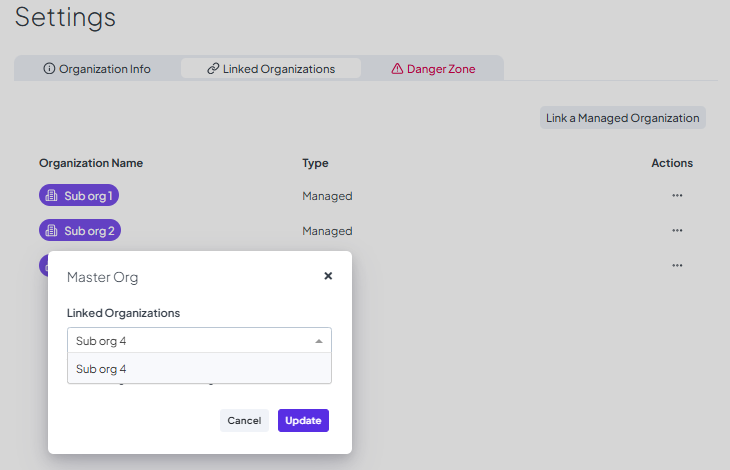
Organization Linking allows you to establish a hierarchy by categorizing organizations into managing (parent) and managed (child) entities. This feature streamlines management and provides centralized [statistics](/doc/organization/statistics.md), including visibility into the spaces of child organizations.
## Danger Zone
{% hint style="danger" %}
The ability to permanently delete the organization. This action is irreversible and will result in the loss of all associated data. Exercise extreme caution when using this feature. Only billing account can delete organization.
{% endhint %}
Delete Organization
---
# Agent Instructions
This documentation is published with GitBook. GitBook is the documentation platform designed so that both humans and AI agents can read, navigate, and reason over technical content effectively. Learn more at gitbook.com.
## Querying This Documentation
If you need additional information that is not directly available in this page, you can query the documentation by asking a question.
Perform an HTTP GET request on the following URL with the `ask` and `goal` query parameters:
```
GET https://docs.decisionrules.io/doc/organization/settings.md?ask=&goal=
```
`ask` is the immediate question: it should be specific, self-contained, and written in natural language.
`goal` is what the user is ultimately trying to achieve, the reason they need the answer. Sharing it helps GitBook give you a better, more relevant answer. A goal is most helpful when it describes the outcome the user wants rather than restating the question. For example, with `ask=how do I create an API token`, a goal like `automate deployments from our CI pipeline` lets GitBook tailor the answer to that use case.
The response will contain a direct answer to the question and relevant excerpts and sources from the documentation.
Use this mechanism when the answer is not explicitly present in the current page, you need clarification or additional context, or you want to retrieve related documentation sections.