> For the complete documentation index, see [llms.txt](https://docs.decisionrules.io/doc/llms.txt). Markdown versions of documentation pages are available by appending `.md` to page URLs; this page is available as [Markdown](https://docs.decisionrules.io/doc/~/changes/1017/organization/policies.md).
# Policies
Policies are set of rules of managing user permissions within a given space. These rules define who has access to what resources, what actions they can perform, and under what conditions access is granted or restricted. By establishing clear policies, organizations can ensure that user permissions are managed in a consistent, secure, and compliant manner.
## List of polices
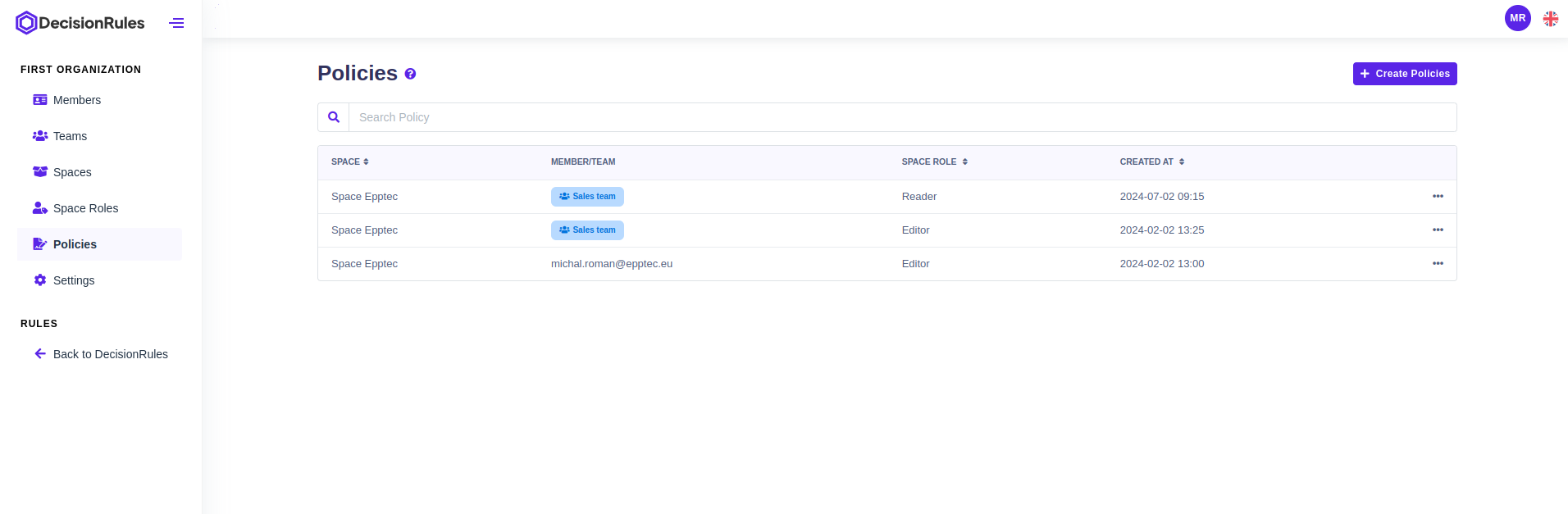
This section outlines the permissions granted to members, teams, or space roles within the system. The table below provides a comprehensive overview of the permissions assigned to each entity within different spaces.
List of policies
### **Description of Columns**
* **Space -** Indicates the name of the space within the application.
* **Member/Team -** Specifies the individual member or team.
* **Space Role -** Describes the role or level of access granted to the member or team within the specified space.
* **Created At -** Displays the date and time when the team was created.
* **Actions -** Provides options to edit or delete policy.
## Crete new policies
The user creates a new policy by clicking the "Create Policies" button. A new window will appear where the user selects the entity (mandatory) that he wants to assign to the policy; space (mandatory) in which the given policy applies and a certain role that the member will hold (what rights he has when accessing the space). Using the "Add Policy" button in the open dialog, allows adding multiple policies at once. The creation of the policy/ies is confirmed by clicking the “Create” button. Newly created policies are added to the policies table.
Create new policy
## Update policy
Each policy can be modified. By selecting the “Edit” option from the action menu on the right. The change is confirmed with the "Update" button.
Open policy editation
Edit policy and save
## Delete policy
Individual Policies can be deleted by selecting the “Remove” option from the action menu. The deletion is confirmed by pressing the "Remove" button. By deleting the Policy, it is removed from the table and the rights it provided are no longer valid.
{% hint style="warning" %}
Deleting policy means that members and teams with given role will loose access to a assigned space.
{% endhint %}
Delete a policy
---
# Agent Instructions
This documentation is published with GitBook. GitBook is the documentation platform designed so that both humans and AI agents can read, navigate, and reason over technical content effectively. Learn more at gitbook.com.
## Querying This Documentation
If you need additional information that is not directly available in this page, you can query the documentation dynamically by asking a question.
Perform an HTTP GET request on the current page URL with the `ask` query parameter, and the optional `goal` query parameter:
```
GET https://docs.decisionrules.io/doc/~/changes/1017/organization/policies.md?ask=&goal=
```
`ask` is the immediate question: it should be specific, self-contained, and written in natural language.
`goal` is optional and describes the broader end goal you are ultimately trying to accomplish on behalf of the user. GitBook uses it to tailor the answer towards what is most useful for that goal.
The response will contain a direct answer to the question and relevant excerpts and sources from the documentation.
Use this mechanism when the answer is not explicitly present in the current page, you need clarification or additional context, or you want to retrieve related documentation sections.