> For the complete documentation index, see [llms.txt](https://docs.decisionrules.io/doc/llms.txt). Markdown versions of documentation pages are available by appending `.md` to page URLs; this page is available as [Markdown](https://docs.decisionrules.io/doc/space/webhooks.md).
# Webhooks
Webhooks are a way to receive notifications and output data from finished jobs running in DecisionRules. This information can either be retrieved manually via the provided [Jobs API endpoint](/doc/api/jobs-api.md) or a webhook can be set up that receives the information automatically upon the Job’s completion.
## How to define a webhook
A new webhook can be defined after navigating into the menu under Space → Webhooks and clicking the “+ Add Webhook” button, or while in an Integration Flow using the “Webhooks” button in the top-right corner.
Access to Webhooks page
Create a Webhook in Rule Designer
For any new webhook you can fill out the following:
* Endpoint URL *(Required)*
* Alias *(Required)*
* Identification of the webhook inside DecisionRules
* Status
* Switch to turn off the webhook without the need of deleting it
* Description *(Optional)*
* Events to send *(Required)*
* You can select which type of events will this webhook be triggered for, for example you can have separate webhooks for successful executions and another one for cancellations and errors
Create a new webhook screen
### Secret
While setting up the webhook you are provided with a secret that can be used to verify incoming messages.
{% hint style="warning" %}
Please note that the secret is shown only in the creation of the webhook and **is not accessible anywhere else**.
{% endhint %}
### Validation Sample
In the webhooks creation screen you are also provided with implementation examples, that highlights the retrieval and verification of the message.
### Assigning webhook to specific rules
When you have your webhook created inside DecisionRules you then have to link it to specific rules so that their completion events are reported.
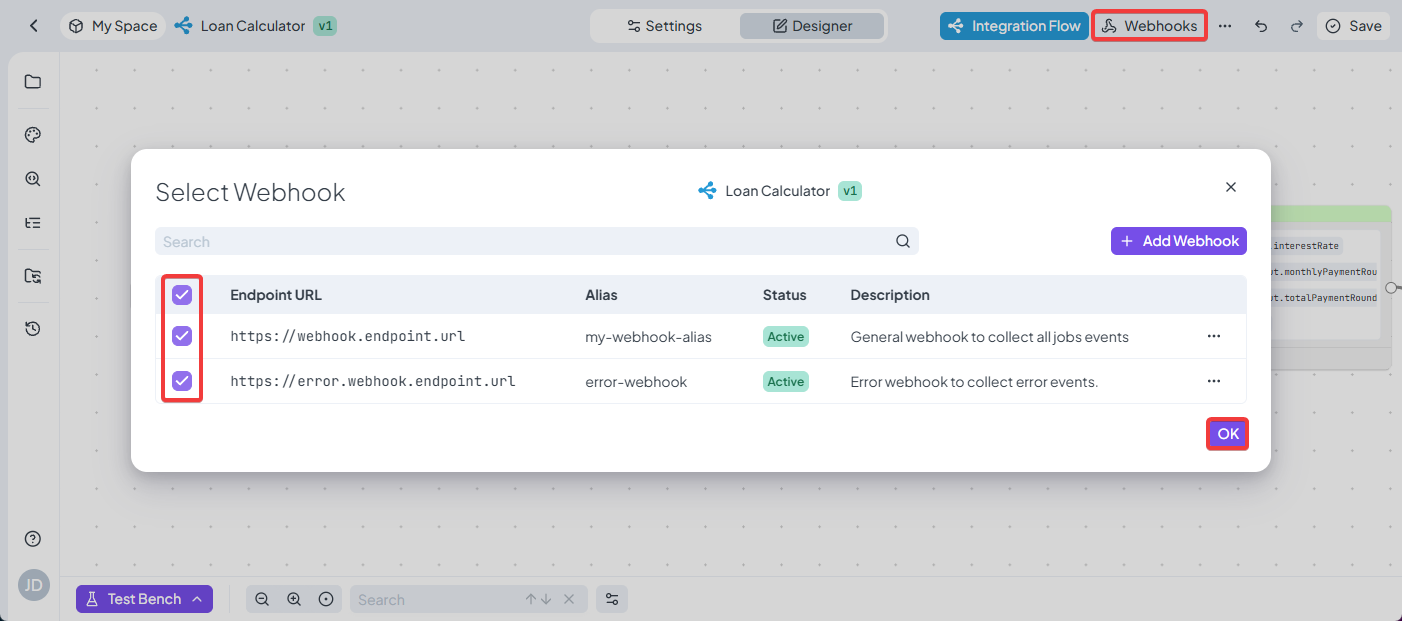
This can be done for any Integration Flow, using the top right menu “Webhooks” and checking all the created webhooks you want to send the events to.
Add Webhook to rule
### Testing Webhook functionality
If you need to test the webhook functionality, or want to see the resulting messages without having to setup the webhook yourself, we would recommend one of the sites that allow you to setup a testing webhook online (e.g., webhook.site).
For this test all you need to do is to take the provided URL, set up a DecisionRules webhook using that URL (nothing else has to be set up), turn on the specific webhook for your Integration Flow and after running a Job you should see a message received with all of the provided data in the service that you are using.
---
# Agent Instructions
This documentation is published with GitBook. GitBook is the documentation platform designed so that both humans and AI agents can read, navigate, and reason over technical content effectively. Learn more at gitbook.com.
## Querying This Documentation
If you need additional information that is not directly available in this page, you can query the documentation by asking a question.
Perform an HTTP GET request on the following URL with the `ask` and `goal` query parameters:
```
GET https://docs.decisionrules.io/doc/space/webhooks.md?ask=&goal=
```
`ask` is the immediate question: it should be specific, self-contained, and written in natural language.
`goal` is what the user is ultimately trying to achieve, the reason they need the answer. Sharing it helps GitBook give you a better, more relevant answer. A goal is most helpful when it describes the outcome the user wants rather than restating the question. For example, with `ask=how do I create an API token`, a goal like `automate deployments from our CI pipeline` lets GitBook tailor the answer to that use case.
The response will contain a direct answer to the question and relevant excerpts and sources from the documentation.
Use this mechanism when the answer is not explicitly present in the current page, you need clarification or additional context, or you want to retrieve related documentation sections.