> For the complete documentation index, see [llms.txt](https://docs.decisionrules.io/doc/llms.txt). Markdown versions of documentation pages are available by appending `.md` to page URLs; this page is available as [Markdown](https://docs.decisionrules.io/doc/rules/common-rule-features/rule-history.md).
# Rule History
{% hint style="info" %}
The **Rule History** feature is not available for **Rule Flow**. You can edit and save a Rule Flow as usual, but its previous versions are not stored or displayed in a history panel.
{% endhint %}
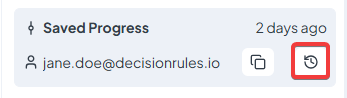
The **History** panel provides a complete overview of all saved versions of a rule.\
Each time you click **Save** in the editor, a new version of the rule is automatically created and recorded here. This allows you to track when and by whom each change was made, and to revisit any previous version when needed.
#### Overview
The **History** panel is located on the left side of the rule editor.\
Each entry in the list shows:
* **Timestamp** – when the rule was saved
* **User email** – who performed the save
* **Current label** – indicates the latest version
The most recent version is always marked as **Current**, while older versions have no label but remain accessible for review.
#### Viewing previous versions
Click any item in the list to open that historical version directly in the rule Designer.\
When selected, the editor will display that version of the rule, allowing you to review its exact configuration at the time of saving.\
To return to your working copy, simply select the **Current** version again.
#### Editing and evaluation rules
Only the **Current** version of a rule is editable and can be executed (tested or run).\
Historical versions are displayed in **read-only mode** — you can view them but not modify or evaluate them.
If you want to bring a historical version back to an editable state, you have two options:
* **Restore historical version** – replaces the current version with the selected historical one. The restored version becomes the new **Current** version and can be edited and evaluated as usual. The previously current version is saved to the history list, ensuring that no data is lost.
* **Clone historical version** – creates a completely new rule based on the selected historical version. The new rule opens immediately in the editor and behaves like any other newly created rule.
{% hint style="warning" %}
Don't forget to change aliase after cloning.
{% endhint %}
#### How it relates to editing
The **History** panel records only *saved* versions of a rule.\
Actions performed using **Undo** and **Redo** affect the current unsaved state of the rule and are not stored here until you save the rule again.
---
# Agent Instructions
This documentation is published with GitBook. GitBook is the documentation platform designed so that both humans and AI agents can read, navigate, and reason over technical content effectively. Learn more at gitbook.com.
## Querying This Documentation
If you need additional information that is not directly available in this page, you can query the documentation by asking a question.
Perform an HTTP GET request on the following URL with the `ask` and `goal` query parameters:
```
GET https://docs.decisionrules.io/doc/rules/common-rule-features/rule-history.md?ask=&goal=
```
`ask` is the immediate question: it should be specific, self-contained, and written in natural language.
`goal` is what the user is ultimately trying to achieve, the reason they need the answer. Sharing it helps GitBook give you a better, more relevant answer. A goal is most helpful when it describes the outcome the user wants rather than restating the question. For example, with `ask=how do I create an API token`, a goal like `automate deployments from our CI pipeline` lets GitBook tailor the answer to that use case.
The response will contain a direct answer to the question and relevant excerpts and sources from the documentation.
Use this mechanism when the answer is not explicitly present in the current page, you need clarification or additional context, or you want to retrieve related documentation sections.