> For the complete documentation index, see [llms.txt](https://docs.decisionrules.io/doc/llms.txt). Markdown versions of documentation pages are available by appending `.md` to page URLs; this page is available as [Markdown](https://docs.decisionrules.io/doc/v1/on-premise-docker/cd-ci-pipelines/azure-devops-cicd-pipelines.md).
# Azure DevOps CICD Pipelines
## Using Azure DevOps CICD Pipelines with DecisionRules Business Rules Engine
{% hint style="info" %}
This page provides a basic example of how to create pipelines with DecisionRules and Azure DevOps. For more advanced or customized pipelines tailored to specific use cases, please refer to **DecisionRules Consulting** for expert guidance and support.
{% endhint %}
#### Introduction
This tutorial will guide you through setting up two CI/CD pipelines using **Azure DevOps** CICD Pipelines to automate the management of business rules in **DecisionRules**. The first pipeline will handle moving business rules from one DecisionRules space to another, even across different environments (e.g., from development to production). The second pipeline will focus on **Restore-in-Time Recovery**, allowing you to revert to a previous state of your business rules when necessary.
#### Prerequisites
Before starting, ensure the following:
* **Azure DevOps** account and project set up.
* **DecisionRules** account with API access.
* A **Git** repository with your DecisionRules configurations and rules.
* [DecisionRules Pipeline Tools basics on Github](https://github.com/decisionrules/decisionrules-cicd-tools)
* Access to a **Service Principal** with appropriate permissions in Azure DevOps.
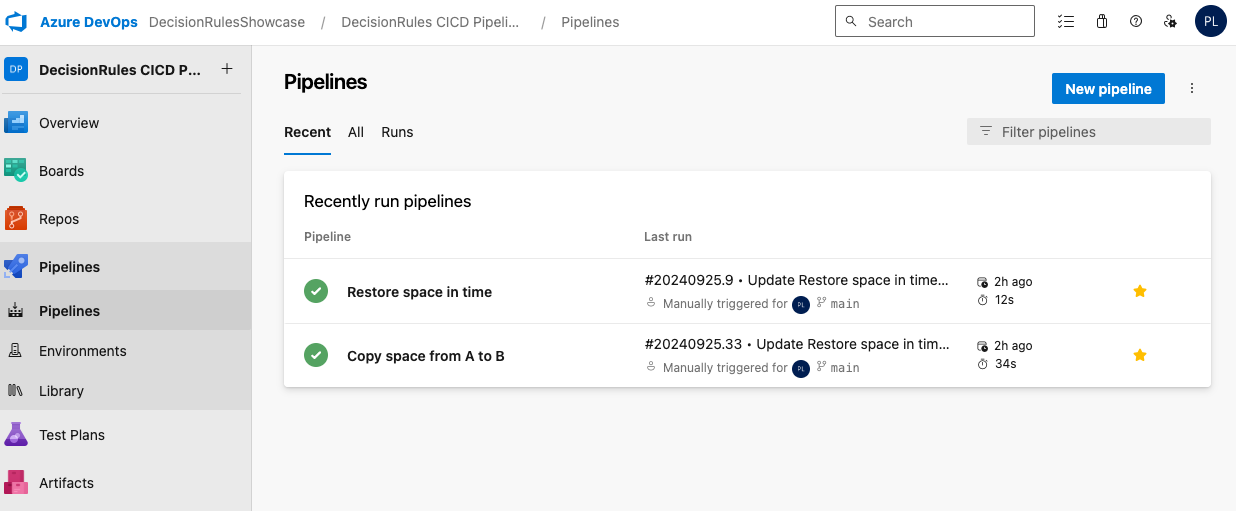
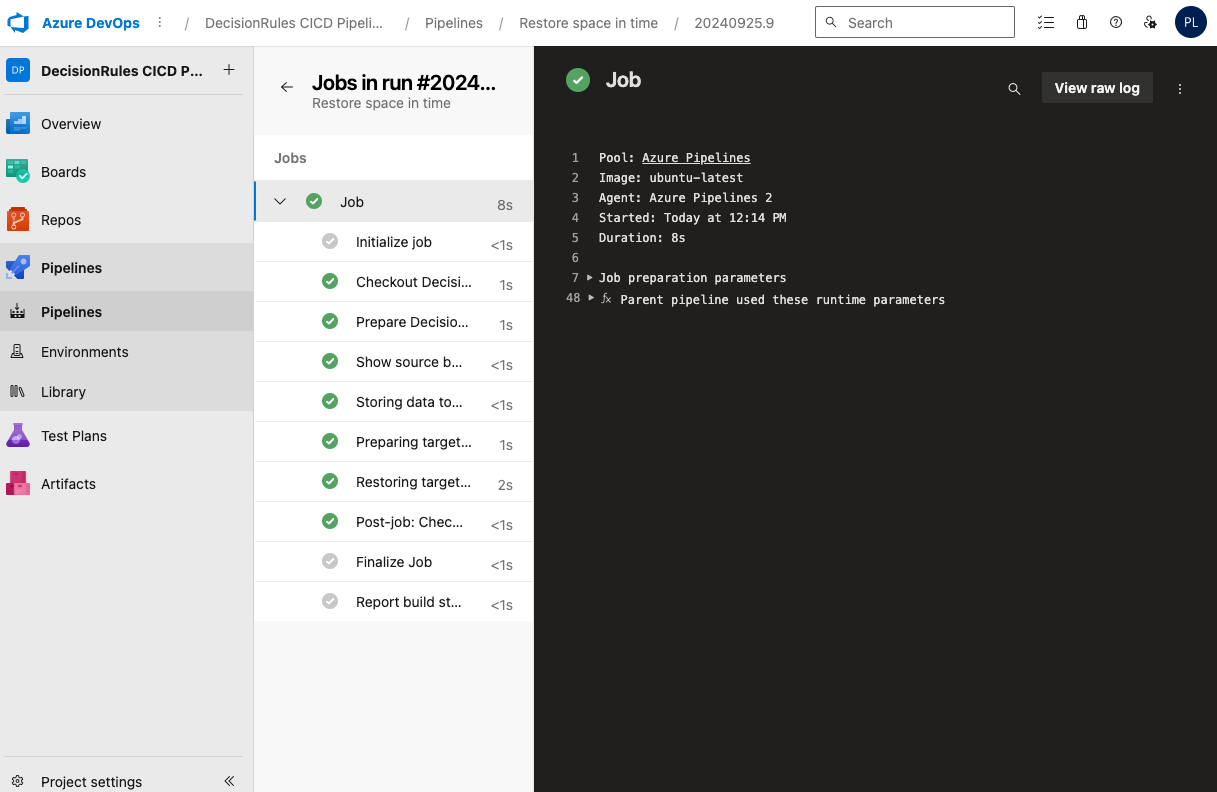
Example of two standard pipeline use cases in Azure DevOps Pipelines
#### Pipeline 1: Moving DecisionRules Business Rules Between Spaces/Environments
This pipeline will automate moving business rules from one space in DecisionRules to another, supporting deployment across different environments such as development, staging, and production.
**Step 1: Create a New Azure DevOps Pipeline**
1. Navigate to your Azure DevOps project.
2. Go to **Pipelines** in the side panel, then select **Create Pipeline**.
3. Choose where your code is hosted (e.g., GitHub, Azure Repos).
4. Select the repository where your DecisionRules configuration and rules are stored.
5. Choose the **Starter Pipeline** or define a YAML pipeline.
**Step 2: Configure YAML Pipeline for DecisionRules Deployment**
The YAML configuration below automates the transfer of business rules between spaces:
```yaml
trigger: none
#External parameters of this YAML pipeline. You can select source environment and target environment
parameters:
- name: srcEnv
displayName: "Source Environment"
type: string
default: "TEST"
values: [ "PRODUCTION", "TEST" ]
- name: destEnv
displayName: "Target Environment"
type: string
default: "PRODUCTION"
values: [ "PRODUCTION", "TEST" ]
variables:
- group: dr-var
pool:
vmImage: ubuntu-latest
steps:
# Get DecisionRules CDCI Pipeline tools from Github
- script: |
git clone https://github.com/decisionrules/decisionrules-cicd-tools.git
cd decisionrules-cicd-tools
npm install
displayName: 'Prepare DecisionRules CICD tools'
# Create branchName variable which represents branch in github repo
- script: |
echo "##vso[task.setvariable variable=branchName;]$(date '+%Y-%m-%d-%H-%M-%S')"
displayName: 'Set variables'
# Create project folder
- script: |
cd decisionrules-cicd-tools
mkdir export
displayName: 'Creating project folder'
# Export source space from source environment
- script: |
cd decisionrules-cicd-tools
npm run export export/export.json $(${{parameters.srcEnv}}_ENV_URL) $(${{parameters.srcEnv}}_SPACE_MANAGEMENT_APIKEY)
displayName: 'Storing source project'
# Create repository, create branch for backup, commit and push exported space to git repository
- script: |
mkdir repository && cd repository
git clone $(GIT_REPO) .
git config --global user.email "release@decisionrules.io"
git config --global user.name "Release Pipeline Agent"
git checkout -b release/$(branchName)
cp ../decisionrules-cicd-tools/export/export.json .
git add .
git commit -a -m 'Storing release'
git push --set-upstream origin release/$(branchName) --force
displayName: 'Storing data to git'
# Also attach deployment artifact to the pipeline.
- task: PublishPipelineArtifact@1
inputs:
targetPath: 'decisionrules-cicd-tools/export/export.json'
artifact: 'Exported Space'
publishLocation: 'pipeline'
displayName: 'Attach deployment artifact to the pipeline'
# Prepare target space for new import
- script: |
cd decisionrules-cicd-tools
npm run clear $(${{parameters.destEnv}}_ENV_URL) $(${{parameters.destEnv}}_SPACE_MANAGEMENT_APIKEY)
displayName: 'Preparing target project'
# Upload tada to target space
- script: |
cd decisionrules-cicd-tools
npm run import export/export.json $(${{parameters.destEnv}}_ENV_URL) $(${{parameters.destEnv}}_SPACE_MANAGEMENT_APIKEY)
displayName: 'Migrating to target project'
```
**Step 3: Set Up Variables**
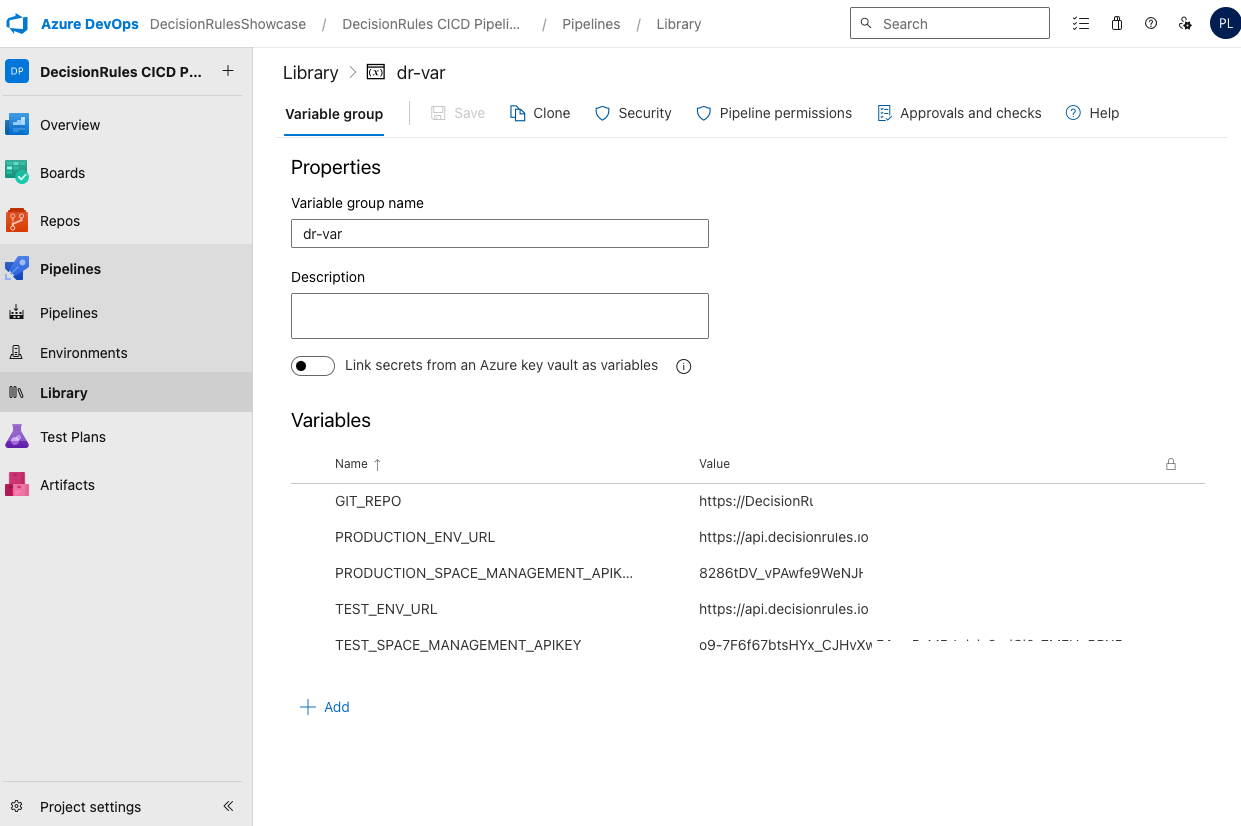
1. In Azure DevOps, navigate to **Pipelines** > **Library** > **Variable Groups**.
2. Create Variable group **dr-var**
1. Add the following variables:
* `GIT_REPO`: Git repository where backups are stored
* `*_ENV_URL`: URL of environment endpoint. This endpoint can be named i.e. as PRODUCTION, DEV, TEST, etc. This prefix is then selected in pipelines parameters section:
```
parameters:
- name: srcEnv
displayName: "Source Environment"
type: string
default: "TEST"
values: [ "PRODUCTION", "TEST" ]
- name: destEnv
displayName: "Target Environment"
type: string
default: "PRODUCTION"
values: [ "PRODUCTION", "TEST" ]
```
* `*_SPACE_MANAGEMENT_KEY`: Decision Rules Management API key that identifies the space on DecisionRules environment
**Step 4: Trigger and Monitor the Pipeline**
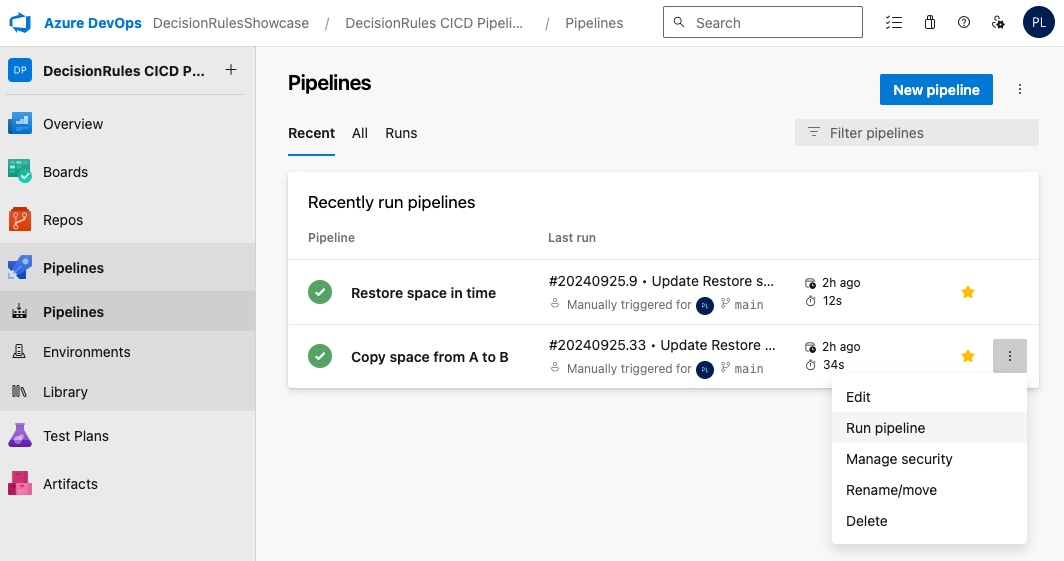
Run pipeline
Once set up, you can trigger this pipeline through code commits or manually and monitor the status from the **Pipelines** page.
***
#### Pipeline 2: Restore-in-Time Recovery Pipeline
This pipeline will allow you to revert to a previous version of a business rule, enabling a restore-in-time recovery for DecisionRules.
**Step 1: Create a New Pipeline for Recovery**
1. Follow the same steps as above to create a new pipeline in Azure DevOps.
2. Name it something like **Restore-In-Time Pipeline**.
**Step 2: Configure YAML Pipeline for Rule Restoration**
Here’s the YAML configuration for the restore pipeline:
```yaml
trigger: none
#External parameters of this YAML pipeline. You select target environment and source branch you want to restore.
parameters:
- name: destEnv
displayName: "Target Environment"
type: string
default: "PRODUCTION"
values: [ "PRODUCTION", "TEST" ]
- name: sourceBranch
displayName: "Select source branch"
type: string
default: ""
#Definition of variable group in Azure DevOps.
variables:
- group: dr-var
pool:
vmImage: ubuntu-latest
steps:
# Get DecisionRules CDCI Pipeline tools from Github
- script: |
git clone https://github.com/decisionrules/decisionrules-cicd-tools.git
cd decisionrules-cicd-tools
npm install
displayName: 'Prepare DecisionRules CICD tools'
# Checkout git branch you want to restore. The branch is pushed to this YAML as sourceBranch parameter
- script: |
mkdir repository && cd repository
git clone --branch ${{parameters.sourceBranch}} --single-branch $(GIT_REPO) .
git config --global user.email "release@decisionrules.io"
git config --global user.name "Release Pipeline Agent"
displayName: 'Storing data to git'
# Prepare DecisionRules space
- script: |
cd decisionrules-cicd-tools
npm run clear $(${{parameters.destEnv}}_ENV_URL) $(${{parameters.destEnv}}_SPACE_MANAGEMENT_APIKEY)
displayName: 'Preparing target project'
# Import data from git repository to DecisionRules space
- script: |
cd decisionrules-cicd-tools
npm run import ../repository/export.json $(${{parameters.destEnv}}_ENV_URL) $(${{parameters.destEnv}}_SPACE_MANAGEMENT_APIKEY)
displayName: 'Restoring target project'
```
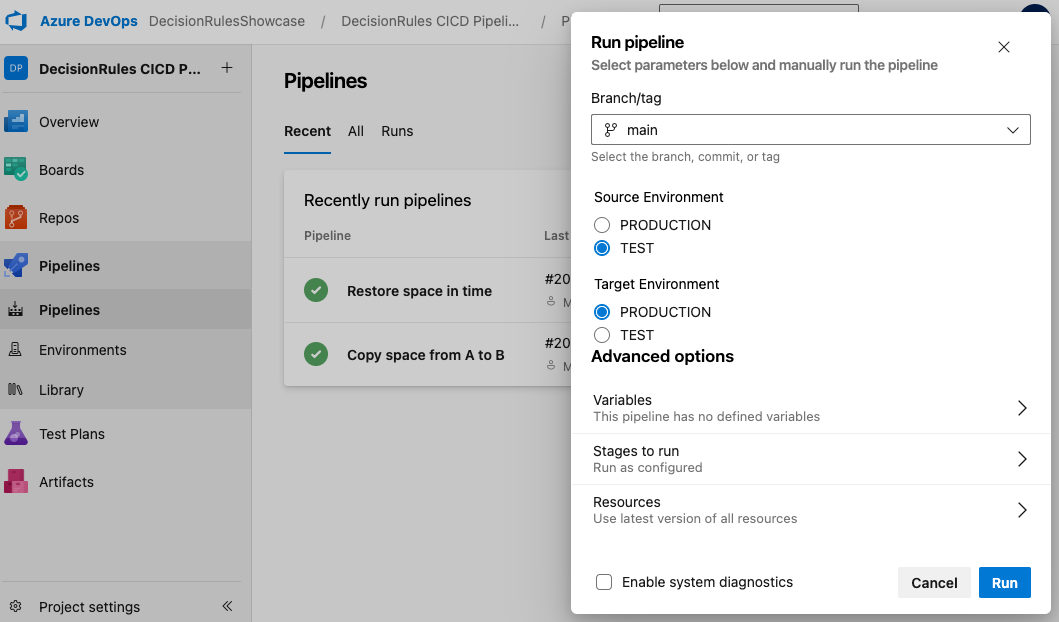
**Step 4: Trigger and Monitor the Pipeline**
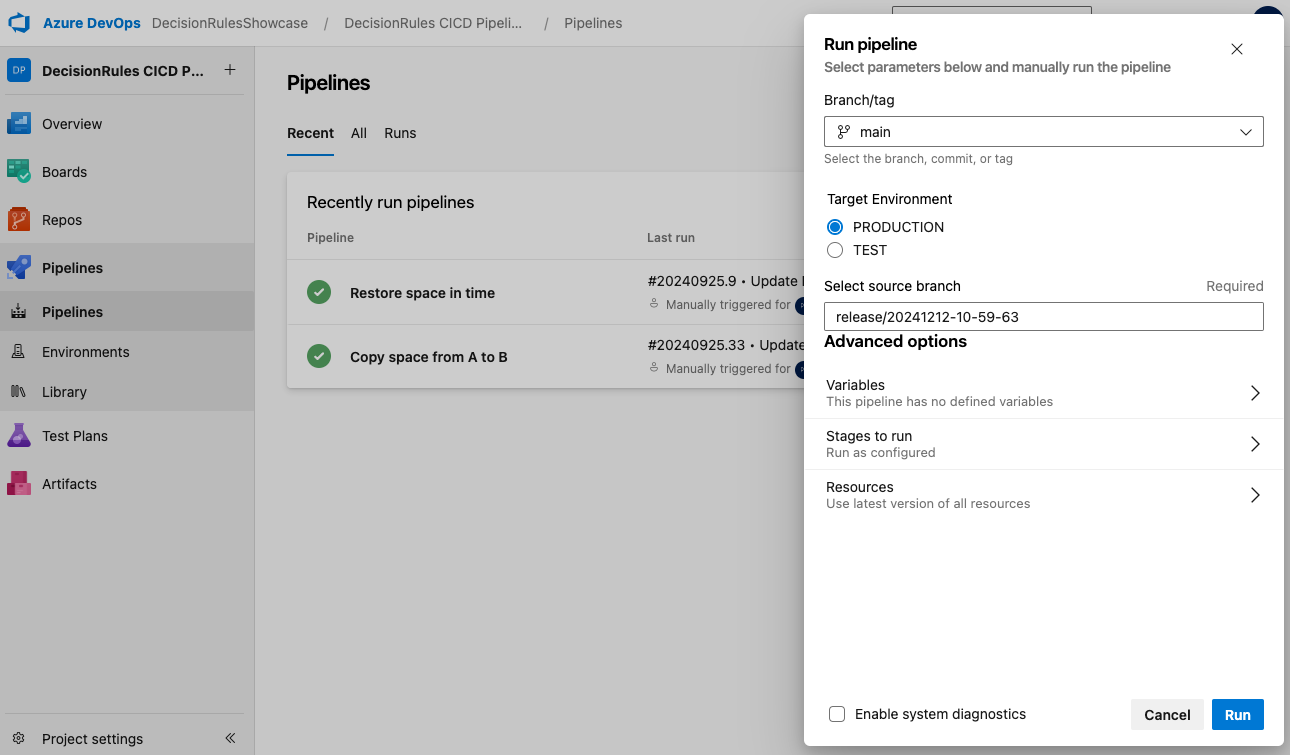
Parameters of Restore space in time pipeline
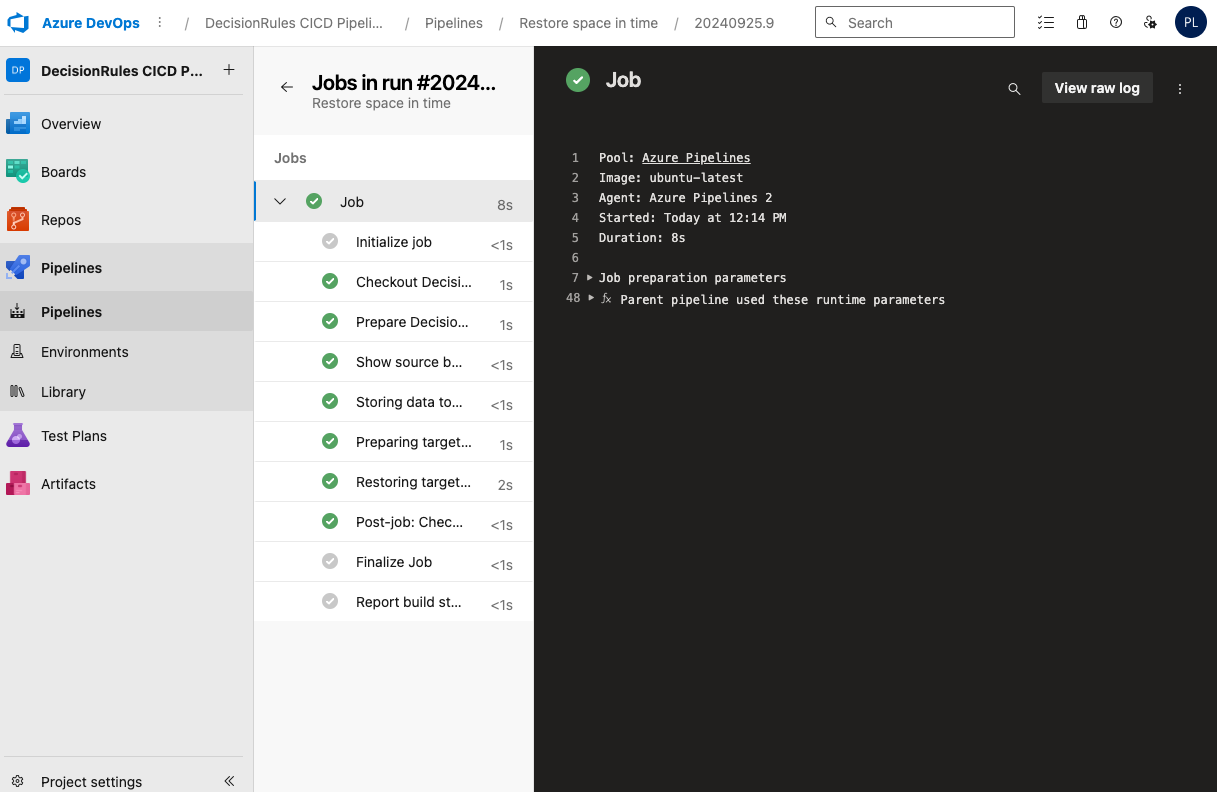
Successful pipeline run
***
#### Conclusion
By setting up these two Azure DevOps pipelines—one for moving business rules between spaces and the other for time-based recovery—you can effectively automate rule management in DecisionRules. These pipelines will help you maintain consistent deployments, streamline environment management, and offer the ability to quickly revert to a previous rule state when needed.
---
# Agent Instructions
This documentation is published with GitBook. GitBook is the documentation platform designed so that both humans and AI agents can read, navigate, and reason over technical content effectively. Learn more at gitbook.com.
## Querying This Documentation
If you need additional information that is not directly available in this page, you can query the documentation by asking a question.
Perform an HTTP GET request on the following URL with the `ask` and `goal` query parameters:
```
GET https://docs.decisionrules.io/doc/v1/on-premise-docker/cd-ci-pipelines/azure-devops-cicd-pipelines.md?ask=&goal=
```
`ask` is the immediate question: it should be specific, self-contained, and written in natural language.
`goal` is what the user is ultimately trying to achieve, the reason they need the answer. Sharing it helps GitBook give you a better, more relevant answer. A goal is most helpful when it describes the outcome the user wants rather than restating the question. For example, with `ask=how do I create an API token`, a goal like `automate deployments from our CI pipeline` lets GitBook tailor the answer to that use case.
The response will contain a direct answer to the question and relevant excerpts and sources from the documentation.
Use this mechanism when the answer is not explicitly present in the current page, you need clarification or additional context, or you want to retrieve related documentation sections.